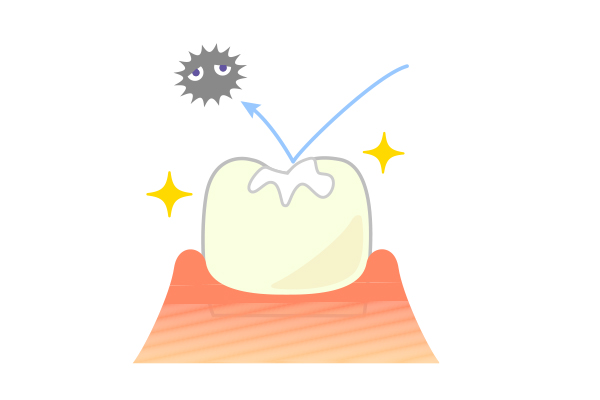
 Dental sealants are among the services a family dentist provides to help prevent tooth decay. Dentists perform the application on the back teeth, or molars, used primarily for chewing. These teeth have tiny crevices and uneven places where the bacteria that can cause cavities are often found. According to the American Dental Association, sealants can reduce the risk of molars developing tooth decay by 80% by sealing off these areas.
Patients of any age can receive this preventative. However, most patients who get sealants are children around the age of 6 whose first molars are just coming in. Early application improves the effectiveness of the prophylaxis. Nevertheless, the ADA also states that less than half of school-age children have sealants, making them almost three times as likely to get cavities.
How do sealants work?
Sealants are made of a clear material such as plastic that adheres to the tooth. This forms a thin, protective coating that creates a barrier between the tooth surface and the acid created when oral bacteria meets food particles. A sealant protects the tooth from destructive acid that can cause tooth decay similar to the way that a raincoat protects a person from getting wet in a rainstorm.
Application
The family dentist works to create a strong bond between the tooth and the sealant. This is accomplished by causing the tooth's surface to become rough through the application of an acidic gel. The dentist applies this after first cleaning and drying the teeth in preparation.
The gel needs only a few seconds to perform its job, after which it gets wiped off, and the dentist dries the tooth again. Once the surface of the tooth is ready, the dentist paints the sealant material directly onto the tooth. The protective coating then needs to dry, which the dentist can accomplish by shining a special blue light into the mouth. The dentist provides the patient with eyewear to filter out the blue light and protect the patient's eyes.
Reapplication
From time to time, sealants wear out and have to be reapplied. A family dentist examines the prophylaxis at regular check-ups and can reapply the sealant once it wears out. This usually takes a number of years.
Are there risks involved with sealants?
Rarely, a patient who gets sealants may have an allergic reaction. Otherwise, there are no known side effects from the treatment, and sealants are considered very safe.
Some people have concerns about the presence of bisphenol A in dental sealants. BPA is an industrial chemical common in plastic food and beverage containers. It is connected with several negative health effects when it seeps from a container into food and drink. However, there is more BPA in cosmetics and household dust than in sealants, and the minimal amount in the latter is not enough to do any damage.
Conclusion
A family dentist uses sealants to protect teeth against decay. Like a raincoat deflects water, the treatment prevents bacteria and acid from reaching the tooth's surface. However, the protection does not last forever, so patients require reapplication every few years or face a greater risk of developing cavities.
Request an appointment or call Sonoran Desert Dentistry at 480-439-0117 for an appointment in our Scottsdale office.
Recent Posts
A family dentist plays a central role in long-term oral health, and choosing the right family dentist helps households stay consistent with preventive care. Because dental needs evolve from childhood through adulthood and into later years, the ideal practice supports a wide range of services in one location. The right choice reduces stress, simplifies scheduling,…
A family dentist might recommend fluoride treatments for patients with decayed or sensitive teeth. These treatments can reverse the demineralization stage of gum disease and strengthen enamel, protecting teeth from decay for up to six months. Fluoride treatments are often performed after teeth cleanings to protect patients until their next routine appointment.Fluoride is a natural…
If you follow recommendations from the American Dental Association, you should visit your family dentist twice a year. These visits provide more than just a cleaning and dental exam; they give you the opportunity to talk with your dentist about proper oral healthcare. While it could be intimidating or embarrassing to open up to your…